Norwegian black metal arson and murder trials and sentencing
Lords of ChaosThe Norwegian black metal arson and murder trials turned a loosely connected music scene into a subject of criminal judgment and national spectacle. In the spring of 1994, testimony and documentary evidence helped secure convictions for Varg Vikernes, Bård Eithun, and others; the sentences ranged from two years to the Norwegian maximum of 21. The proceedings punished particular crimes, but they also exposed a struggle over who could define them: as retaliation, self-defense, Satanic threat, youth delinquency, or proof of a cultivated reputation for extremity.
Background: Retaliation and reputation
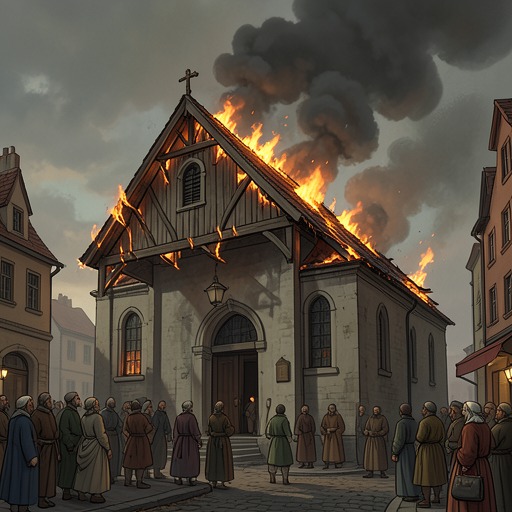
The church arsons were not presented as a coordinated campaign in any simple sense. Reviewing case literature, the book compares the church-burners with revenge-motivated arsonists and notes that Vikernes and others convicted of burning Norwegian churches framed their acts as retaliation against Christianity. That account supplied a rationale, not an impartial finding about motive: the fires were destructive acts, while the perpetrators’ language recast them as answers to an earlier historical and religious wrong.
Vikernes disputed the idea that he had led an organized group. In an interview, he denied that there had been an organization, said that one person had started the arson sequence, and stressed that he had not been found guilty of burning Fantoft Stave Church. He nevertheless described that fire as the trigger for what followed. He also contested the Satanic interpretation attached to its date, June 6, 1992, pointing instead to the Viking raid on Lindisfarne in 793. The competing readings—numerical symbolism and historical reference—show how the same event could be made to serve different accounts of identity and intent.
The broader scene had already cultivated a deliberately sinister public image. The book describes Øystein Aarseth as recognizing the value of presenting Mayhem as militantly evil, in keeping with a stated aim of spreading evil to a mass audience. The band’s rare live performances, including its 1990 Sarpsborg concert, helped turn that image into a reputation. This mattered to the later proceedings because the scene’s theatrical language and its actual crimes would be read together, even when one did not establish the cause of the other.
Testimony, evidence, and competing accounts
The court proceedings assembled a wide-ranging record: a record contract Vikernes carried to Oslo, letters by him and others, maps, forensic reports, and the Bergens Tidende article that had become infamous. Testimony implicated witnesses as well as defendants. Vikernes held to a code of silence and regarded those who testified about criminal activity as informers; the book emphasizes that confessions and testimony often implicated the people giving them.
Vikernes also explained the murder of Øystein Aarseth through an asserted threat. He said he had heard in detail that Aarseth planned to shoot him with a stun gun, tie him up, and torture him. In his account, he believed Aarseth would eventually kill him and argued that he therefore acted first. He described his own response as a matter of reciprocal honor: he would treat someone honorably if he expected honor in return, but would show no mercy to someone he believed intended to harm him. These statements preserve Vikernes’s justification; they do not erase the trial testimony, which characterized the killing as premeditated.
That testimony described Vikernes as having two accomplices. Snorre Westvold Ruch accompanied him on the seven-hour drive from Bergen to Oslo, while another friend remained in Vikernes’s Bergen apartment. The contrast between Vikernes’s personal account of an anticipated attack and the evidence of planning gave the murder case two sharply different frames: immediate, claimed self-preservation on one side, and a premeditated act involving assistance on the other.
Convictions and sentences
The proceedings resulted in Vikernes’s conviction for murder, arson, and possession of illegal weapons. In his own summation, he said that his 21-year sentence covered three church fires, an attempted burning of a bell tower, theft and storage of 100 kilograms of dynamite and 50 kilograms of glynite, and break-ins at cabins in which two books were stolen. He acknowledged confessing to the explosives offense, while disputing the evidentiary basis for the fire convictions. His account is a defendant’s characterization of the verdict and its supporting evidence; the book separately reports that the statements and police interviews presented at trial were sufficient to convict him.
Vikernes was 21 when he received the maximum sentence of 21 years, which the book describes as the Norwegian equivalent of a life sentence and notes was to be served in maximum security. Bård Eithun received 14 years for murder. Ruch, identified as Vikernes’s accomplice in the killing of Aarseth, received eight years. Other participants in church arsons, including Samoth and Jørn Inge Tunsberg, had confessed to police and received sentences of two to three years in minimum-security institutions. Many people involved in the arsons were also fined to cover damages and reconstruction costs.
Two more churches were burned on the day Vikernes was sentenced. The book presents the fires as presumably intended as symbolic support, not as a proven statement by identified perpetrators. Their timing nonetheless made sentencing day an unsettling coda: a legal judgment intended to close a period of crime was accompanied by new destruction.
Public judgment and the reach of the story
During the spring 1994 proceedings, Vikernes became a pariah in the national consciousness. Newspapers and television focused on him, while his own public statements supplied material that intensified the coverage. The case therefore unfolded not only in court but in a contest over image: the media could present him as a national threat, while his own defiance and claims of sinister purpose helped make him a near-mythological figure in the subculture.
Asbjørn Dyrendal later described young people trying to imitate Satanism as they had encountered it through media and Christian accounts. In his reading, Vikernes sometimes played into the stories circulating about the scene, implying knowledge of killings and then refusing to discuss them in a way that suggested more than he admitted. Dyrendal also reconsidered the media’s role: attention helped Vikernes build street credibility and intensified internal competition to become the scene’s dominant personality. He noted that people within the scene said things became wilder after mass coverage began, while cautioning that the scene also had internal dynamics of its own.
Vikernes later said that, after the arrests and the accompanying publicity, many young people became attracted to the scene, and that many subsequent church fires were committed by children who had entered it after the arrests. The book places this claim alongside a broader account of cultural transmission rather than treating the sequence alone as proof of cause. Its discussion traces a possible path from Venom’s knowingly theatrical Satanic image, through Norwegian teenagers who took that imagery seriously, to a Norwegian scene that made the fantasy seem more real and exported a more extreme model. Articles in Kerrang!, Spin, Fortean Times, and other publications helped make Norway synonymous with Black Metal in popular awareness, while the book stresses that the music and its surrounding ideology were spreading internationally. The trials thus marked both a legal reckoning and a moment when media attention helped carry the scene’s image far beyond the country in which its best-known crimes had occurred.